

8 Parisian mansions that have become the setting for movies and TV series
In Paris, some places are not content with simply being beautiful or steeped in history: they also play a role in the arts.
For over a century, cinema has been using Parisian mansions to embody power, wealth, aristocracy, artistic creation and contemporary luxury.
Private monuments turned into museums, aristocratic residences transformed into fictional settings, these buildings have stood the test of time… both on screen and in the city.
Here are 8 Parisian mansions that have marked the history of cinema and television series, from The Party (La Boum) to Mission: Impossible, from Claude Sautet to Sofia Coppola, right up to the most recent productions.

1. Hôtel de Soubise
A former 18th-century princely palace that became the headquarters of the National Archives, the Hôtel de Soubise is one of those places that cinema loves for its ability to embody power — whatever form it may take. On screen, it changes function, era and register, without ever losing its majesty.
In Papy fait de la résistance, it is the headquarters of the Kommandantur during the Occupation, but above all the setting for a burlesque scene in a film that has no shortage of them. Nothing better, it is true, than a prestigious setting to desacralise authority and act of… resistance!
More recently, the hotel played a substitute Versailles in Sofia Coppola’s Marie Antoinette. Since then, the venue has appeared in numerous projects. In Mission: Impossible – Fallout, for example, after the sequence at the Grand Palais, Hunt (Tom Cruise) flees with the White Widow (Vanessa Kirby) to his Parisian residence.
One setting, three eras, three genres: cinema loves its rococo salons and theatrical courtyard.

2. Hôtel de Lauzun
A 17th-century masterpiece designed by Louis Le Vau, the king’s chief architect and builder of the Château de Vaux-Le-Vicomte, the Hôtel de Lauzun is famous for its Baroque décor and literary past. Charles Baudelaire and Théophile Gautier stayed there and founded the mysterious Club des Haschischins.
It recently appeared in The Three Musketeers (M. Bourboulon, 2023) as the apartments of the Queen of Austria (Vicky Krieps). A few years ago, Cédric Klapisch shot a memorable scene from his film Paris (2008) there. Fabrice Luchini, a history teacher, comments passionately on the place. Here, cinema joins forces with heritage transmission in a perfect mise en abyme.
A mansion that speaks of Paris… in a film about Paris, it’s very meta and therefore particularly appealing to Ciné-Balade.

3. Hôtel Marcel Dassault
From the cult teen comedy The Party 2 (La Boum 2) to the historical film See You up There (Au revoir là-haut), the Marcel Dassault hotel has been part of French cinema for over forty years.
Built at the end of the 19th century in the Louis XV style, it was the home of actress Sophie Croizette, a friend of Sarah Bernhardt, before being acquired by Marcel Dassault in 1952.
As the industrialist was the producer of Claude Pinoteau’s film, he lent his living room to the crew for the opening scene, in which Vic (Sophie Marceau) and Poupette (Denise Grey) attend a concert in Vienna. The art of travelling on a budget, as the hotel’s interior perfectly reflects Austrian Rococo style.
However, it is the hotel’s opulent exterior that catches the camera’s eye next. In See You up There (Au revoir là-haut), it is the home of Marcel Péricourt (Niels Arestrup) and the setting for a night-time scene between Albert (Albert Dupontel) and Pauline (Mélanie Laurent). Antonio Banderas can also be seen there, filmed by Brian de Palma in Femme Fatale.
Alternately a social salon, a bourgeois residence, or a spectacular façade, the Marcel Dassault Hotel perfectly illustrates how cinema recycles prestigious locations to better traverse eras and imaginations.
4. Hôtel de la Païva
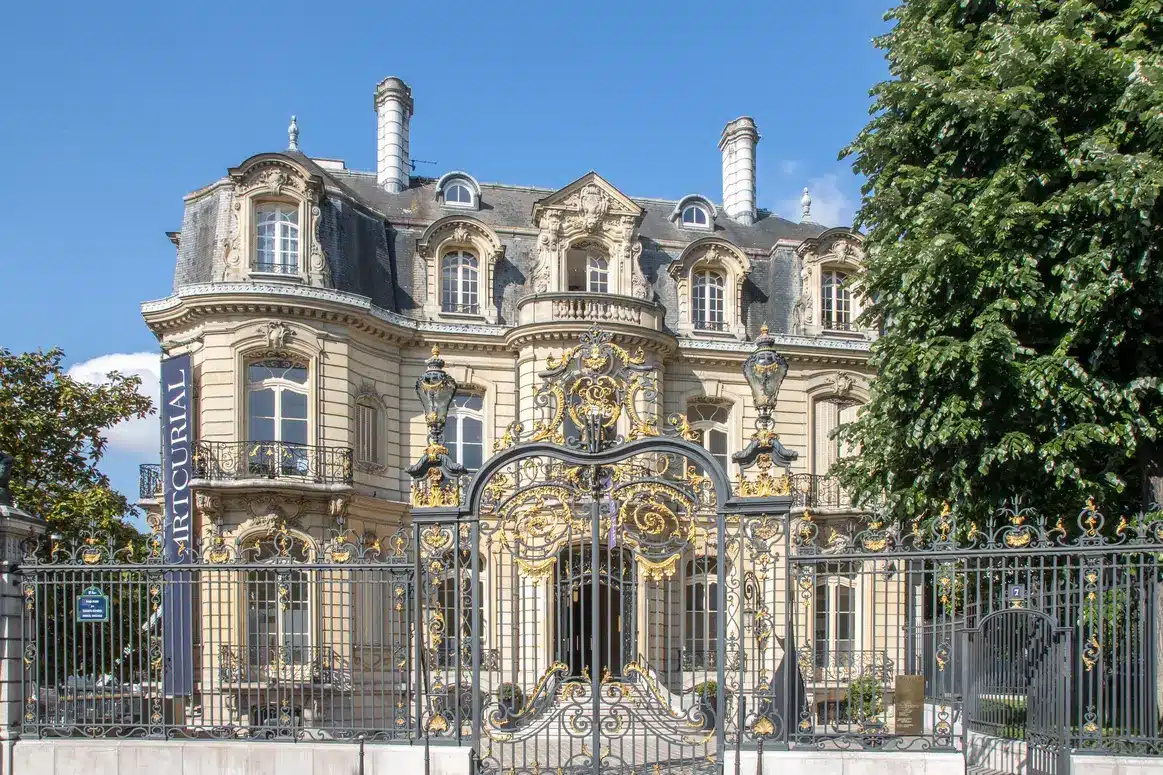
After the official salons and palaces of power, it was time for another type of prestige, more flamboyant and theatrical: that of the Hôtel de la Païva. With its onyx staircase, gilding and Second Empire splendour, the residence was a veritable movie star. Commissioned by the most famous Parisian courtesan, Thérèse Lachman, alias the Marquise de Païva, it stands as a revenge for her impoverished youth and is now the last private mansion on the Champs Elysées.
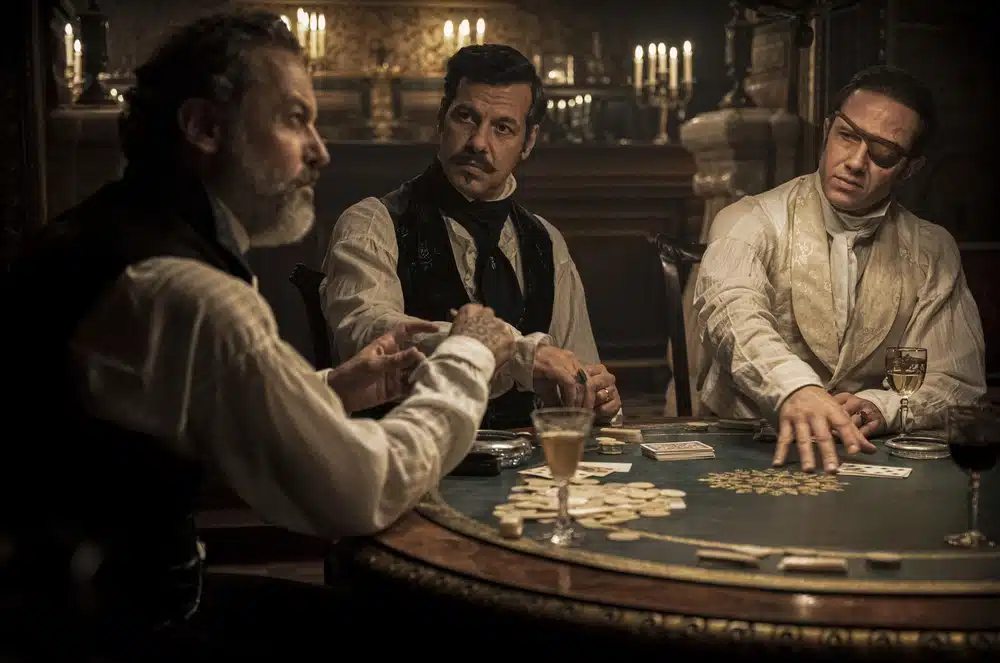
The location embodies the poetic and offbeat world of Mood Indigo, the 19th century reinvented in Eiffel, bourgeois abundance in See You up There (Au revoir là-haut) and the romantic and vengeful Paris of Dumas in The Count of Monte Cristo. It is in the latter film that viewers can best enjoy the splendour of its interior décor.
Ballroom scenes, the poker scene, the scene where Albert de Morcerf and Haydée cross paths on the magnificent staircase, or the moving conversation between Edmond Dantès and Mercédès in the winter garden: here, the decor becomes a character in its own right.
5. Hôtel d’Avaray
Dating back to the early 18th century, it was built at the same time as its neighbour, the Pozzo di Borgo mansion, which appears in the film The Intouchables.
The latter was the home of Philippe Pozzo di Borgo, the quadriplegic businessman whose friendship with his carer, Abdel Sellou, inspired the film starring François Cluzet and Omar Sy. However, as the location was unavailable for filming, Eric Tolédano and Olivier Nakache turned to the Hôtel d’Avaray, the residence of the Dutch ambassador since 1920. At his request, the entire fee was donated to the Cité Internationale Universitaire de Paris for the restoration of the Dutch college, one of the most beautiful on the site.
Since then, two projects led by Omar Sy have used the hotel as a setting for one or more sequences: David Charhon’s On the Other Side of the Tracks (De l’autre côté du Périph) and the series Lupin, which features it as the residence of Hubert Pellegrini, his sworn enemy.
From biographical reality to contemporary fiction, the Hôtel d’Avaray embodies on screen a Parisian elite that is both inaccessible and deeply cinematic, where the setting plays a key role in the construction of the characters.

6. Nissim de Camondo Museum
A former private mansion turned museum, Camondo is one of the most filmed locations in Paris. Located on the edge of Parc Monceau, it was built between 1911 and 1914 for the banker Nissim de Camondo, a great collector of 18th-century art objects, which he brought together to recreate an aristocratic residence of the period. The building and its collection were donated to the Musée des Arts Décoratifs at his request.
Its superb décor and neoclassical style attract international productions and are suitable for all periods.
Firstly, due to its history, it seems a natural choice to represent the family home of the wealthy financier Noël Schoudler (Jean Gabin) in Les Grandes familles (Denys de la Patellière, 1958). It also features as the Zurich bank where Sophie Neveu and Robert Langdon go in The Da Vinci Code.
As for its interior décor, consisting of 18th-century furniture, paintings, carpets, porcelain and silverware, it is perfectly suited to the libertine world of the film Valmont, Milos Forman’s film adaptation of Dangerous Liaisons.
Other examples include the home of the Levasseurs (Daniel Auteuil and Kristin Scott Thomas) in The Valet (La Doublure), and, in terms of television series, the exteriors of the residence of Lupin’s arch-enemy, Hubert Pellegrini, and that of the Lenverprés (Audrey Fleurot and Gilbert Melki) in The Bonfire of Destiny (Le Bazar de la Charité).
A place of power and money, mystery and fantasy, the museum is a key setting for films where history and stories can be read in the walls.

7. Rodin Museum
Rarely has a place been filmed in such a diverse manner.
The Rodin Museum, the sculptor’s former home and a place of contemplation for admirers of his work, is a notable feature in many films that showcase French art and culture. Whether it’s the gardens conducive to daydreaming or the rooms filled with a thousand masterpieces, the place has long been a source of inspiration.
The museum’s website cites Claude Sautet, James Ivory, Tran Anh Hung and Jean-Luc Godard. We can also recall François Truffaut paying tribute to Rodin’s sculpture of Balzac in Two English Girls (Les Deux Anglaises et le Continent), Poupette reminiscing about her artistic and liberated youth in Vic in The Party (La Boum 2), and Woody Allen offering us a tourist and cultural discovery of the city in Midnight in Paris through a guided tour given by Carla Bruni.
The Rodin Museum is a true cinematic chameleon, reminding us of the love between the seventh art and the second.

8. Hôtel de Beauvais
A magnificent 17th-century mansion located in the Marais district not far from the Hôtel de Ville, the Hôtel de Beauvais was built by Antoine le Pautre, Louis XIV’s chief architect. It later became the Bavarian embassy and hosted the young Mozart, aged 7, for six months during his first European tour. It later became an apartment building, was classified as unfit for habitation in the 20th century, and remained in a state of serious disrepair until its restoration in the 1990s and the establishment of the headquarters of the Paris Administrative Court of Appeal.
Virtually abandoned since the 1980s, it was the ideal setting for several French films, which today bear witness to the state of the mansion at that time.
Its theatre-shaped courtyard is easily recognisable, having been very popular with filmmakers in Francis Girod’s The Lady Banker (La Banquière) (1980) and Bruno Nuytten’s Camille Claudel (1988). The bank and home of Emma Eckhert (Romy Schneider) in the former, it becomes the home and studio of Camille Claudel (Isabelle Adjani) – originally located on the Île Saint-Louis – in the latter. It is also worth noting that it appears in Philip Kaufman’s The Unbearable Lightness of Being, in which Paris stands in for the city of Prague.
Through these films, the Hôtel de Beauvais preserves on screen the memory of a long-forgotten place, which has become a precious backdrop for recounting the fragility, creativity and upheavals of history.

From the 17th century to the present day, these mansions have mapped out luxury, power and social representation in cinema.
Whether they embody the aristocracy of the Ancien Régime, the triumphant bourgeoisie, contemporary elites or fantasies of prestige, these Parisian locations play a key role in film narratives.
On screen, they are not merely a backdrop: they tell a story, that of a Paris constantly reinvented through the eyes of filmmakers.
It’s another way to explore the city, following in the footsteps of fiction… and cinema.