
Paris by Cédric Klapisch
For Cédric Klapisch, filming Paris has never been about presenting a monumental or static image. Since his early films, the filmmaker has been constructing an intimate geography, made up of specific streets, micro-neighbourhoods, cafés and inhabited buildings. For him, Paris is a living organism, undergoing social, generational and architectural changes. Each film corresponds to a clearly defined territory, observed with almost documentary-like attention. Bastille, northern Paris, La Villette, Montmartre: these are all fragments that make up a sensitive cartography of contemporary Paris.

Bastille, a village in transition – So tired of being alone (Chacun cherche son chat)
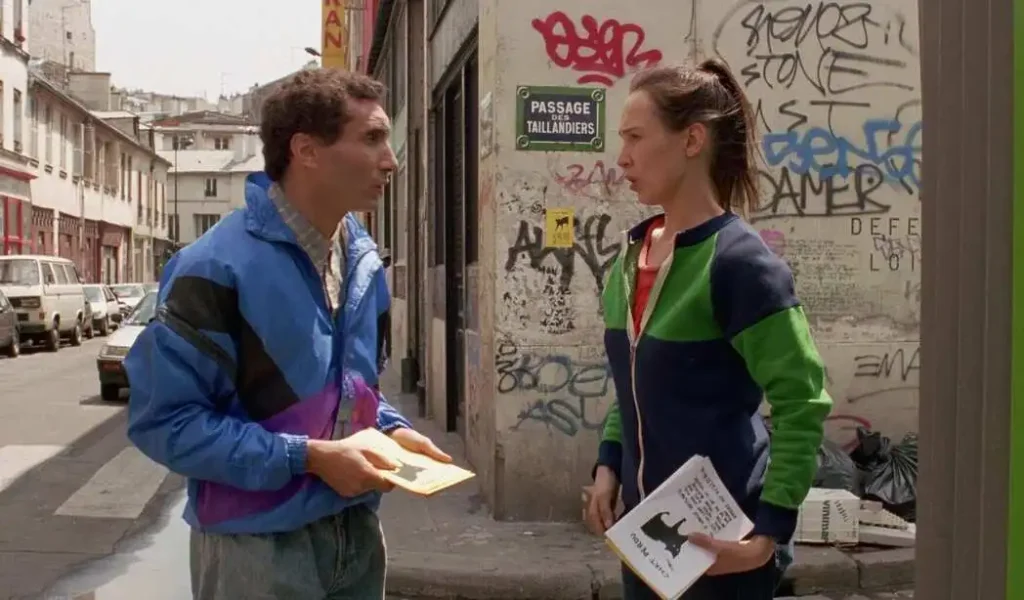
With So tired of being alone (Chacun cherche son chat), Cédric Klapisch firmly anchors his cinema in the Bastille–Roquette neighbourhood. Rue Keller, Rue des Taillandiers, Rue de Charonne, Passage de la Main-d’Or: everything takes place within a few hundred metres. The filmmaker captures a working-class Paris in the midst of transformation, at a time when artisan workshops still rub shoulders with trendy new bars, and gentrification is beginning without having completely erased neighbourhood life.
The disappearance of a cat becomes the pretext for interaction between the residents: a young woman, an old lady, a slightly showy neighbour, shopkeepers. Klapisch works almost like an urban ethnologist. Alongside the lead actress (Garance Clavel) and his favourite actors (Zinedine Soualem, Romain Duris, Simon Abkarian), he avoids extras and favours real residents he met during location scouting. He also chooses to shoot often without extensive preparation. This method gives the film a very special human texture, where fiction feeds directly on reality. Bastille appears here as an urban village, fragile, supportive, already threatened by the changes to come.
North Paris, contemporary loneliness – Someone, Somewhere (Deux moi)
Twenty-four years later, Someone, Somewhere (Deux moi) returns to this founding idea of the neighbourhood film, but in a profoundly transformed Paris. Klapisch chooses a very specific area, located between Goutte-d’Or, Gare du Nord and Porte de la Chapelle: Rue Stephenson, Boulevard de la Chapelle, Rue Marx-Dormoy. It is an enclosed neighbourhood, surrounded by railway tracks and structured by bridges, rails and the elevated metro, where our two heroes (Ana Girardot and François Civil) pass each other without seeing each other.
This choice is not insignificant. Klapisch is struck by these buildings with double facades, facing both the street and the railway tracks: a configuration that he immediately considers cinematic. The neighbourhood becomes a reflection of the characters’ inner state: geographically close, but psychologically separated. As in So tired of being alone, the filmmaker recreates a village atmosphere, but a contemporary village, marked by isolation and loneliness in the age of connectivity. The presence of a cat, the appearance of Madame Renée, an emblematic figure from the 1996 film, and Simon Abkarian as a warm-hearted grocer create a discreet link between the two works, like an echo twenty years apart.

Adolescence and urban memory – Good Old Daze (Le Péril jeune)
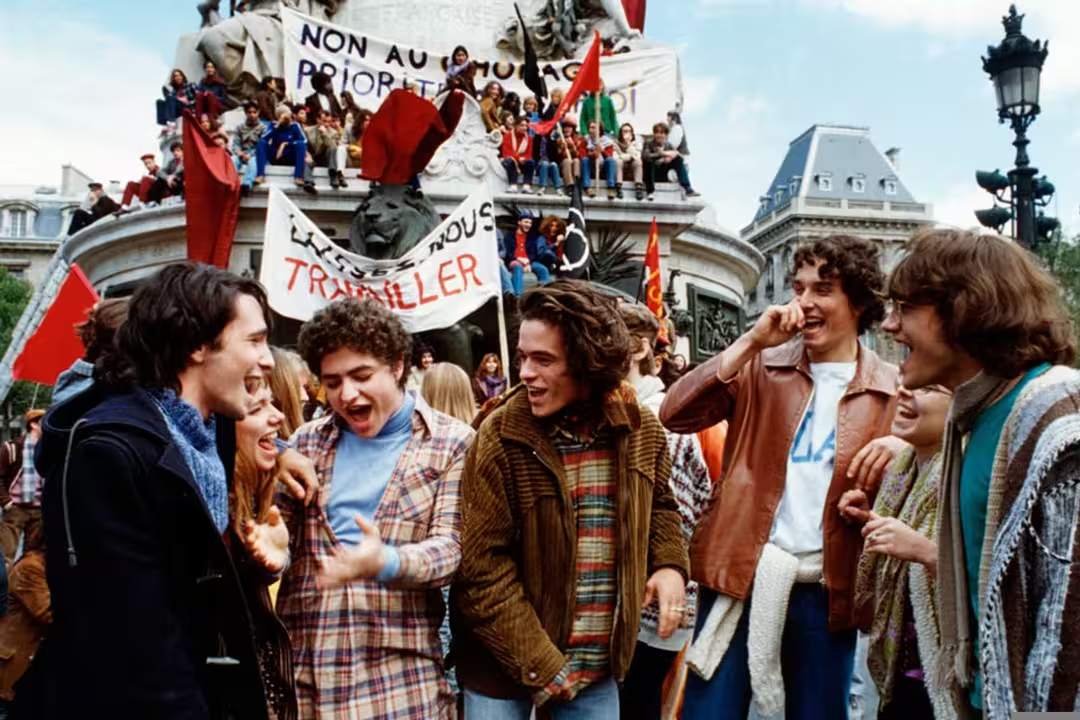
With Good Old Daze (Le Péril jeune), Klapisch films Paris from the perspective of teenagers at a pivotal moment in time: the mid-1970s. Although the high school is fictional, the film is deeply rooted in northern and eastern Paris: Barbès, the Ourcq Canal, Orgues de Flandre, working-class neighbourhoods destined for profound change. The filmmaker captures a youth still marked by the legacy of May 1968, but already confronted with the end of collective ideals.
The filming, which was quick and low-budget, often took place in locations before they were renovated. Klapisch was aware that he was filming a Paris on borrowed time, and Good Old Daze now serves as a veritable time capsule. The city is not idealised: it is lived in, travelled around on mopeds, traversed by all these young people, with a raw and melancholic energy.
Canal Saint-Martin and transit neighbourhoods – Russian Dolls (Les Poupées russes)
In Russian Dolls (Les Poupées russes), as in The Spanish Apartment (L’Auberge espagnol), of which it is the sequel, Cédric Klapisch broadens Xavier’s (Romain Duris) trajectory to a European scale, but Paris remains an essential anchor point, filmed through spaces of passage and transition. The Canal Saint-Martin, with its quays and cafés, as well as the Île Saint-Louis and the neighbourhood where Martine (Audrey Tautou) lives in the 9th arrondissement, offer counterpoints to the hustle and bustle of the story. It is notably at the Café L’Atmosphère on the Quai de Valmy that the reunion scene takes place, which leads to the gang getting back together. In contrast, the area around the Gare du Nord embodies a Paris in motion, with comings and goings symbolising emotional and professional trajectories. Klapisch films these neighbourhoods as places of constant movement, mirroring his characters: between two ages, between two countries, between several possible lives.

The city in movement – Rise (En corps)
In Rise (En corps), Klapisch explores Paris through dance and movement. The film crosses the Place Dauphine and the Théâtre du Châtelet, then films the park and the Grande Halle de la Villette. A former industrial site converted into a cultural centre, La Villette perfectly embodies the idea of transformation that runs through the filmmaker’s entire body of work.
Klapisch readily refers to it as an ‘anti-Black Swan’. He rejects the glorification of suffering and chooses to work with real dancers, filmed in their physical and collective reality. Marion Barbeau, principal dancer at the Paris Opera, was nominated for a César Award for Most Promising Actress for her performance. Here, the city is sometimes an extension of the body: staircases, bridges and urban platforms are used as choreographic spaces. Paris is no longer just observed, it is inhabited by movement.

Montmartre, between past and future – Colours of Time (La Venue de l’avenir)
With Colours of Time (La Venue de l’avenir), Klapisch returns to Montmartre several years after filming there for a few scenes in The Spanish Apartment (L’Auberge espagnol) (remember the narrowest pavement in Paris, Rue d’Orchamps, and the break-up scene at the Café Au Soleil de la Butte). In his new film, he focuses on the neighbourhood at the end of the 19th century. The still-popular streets, artists’ studios, modest cafés and windmills surrounded by fields herald the mythification to come. We think we recognise Rue des Saules and the top of the hill, then we realise that the director has reinvented them with his palette of digital effects.
Montmartre is here a place of transition, a place of memory for some and of invention for others. True to his obsession with moments of transition, Klapisch films a neighbourhood in the making, an artistic and social laboratory where photographers, musicians, painters and models meet. The film also provides an opportunity to encounter Claude Monet, Nadar, Victor Hugo and Sarah Bernhardt.

Paris, global city – Paris
With Paris, Klapisch changes scale without abandoning his method. The film adopts an ensemble narrative and traverses several neighbourhoods – Belleville, Ménilmontant, Île Saint-Louis, the Sorbonne, Notre-Dame – to paint a portrait of a fragmented city, criss-crossed by destinies that intersect or ignore each other. The character of the professor, played by Fabrice Luchini, acts as a guiding thread, reminding us that Paris is made up of layers, of constant contrasts between old and new. More than just a backdrop, the city becomes an invisible link, a common matrix for very different lives.