
The Cité Universitaire Internationale de Paris in movies
In the 14th arrondissement of Paris lies a unique area that is part university campus, part landscaped park and part open-air film set: the Cité Universitaire Internationale de Paris.
Covering 34 hectares, this vast complex welcomes more than 10,000 students from all over the world every year… as well as dozens of film crews.
For several decades now, the Cité Universitaire has been the leading film location in the Île-de-France region, with more than sixty productions a year. Art films, popular comedies, historical dramas and biopics are all filmed here, attracted by a rare asset in Paris: the opportunity to travel without leaving the capital.

An ideal setting for cinema
Created after the First World War in a spirit of peace, dialogue and understanding between peoples, the Cité Internationale Universitaire was conceived as an architectural and humanist utopia.
Its 37 houses, designed between the 1920s and 1960s, reflect the cultural and architectural diversity of the world: English, Flemish, Italian, Japanese, Indochinese and modernist influences.
For cinema, it is an exceptional playground.
Within the same perimeter, directors can film an Anglo-Saxon campus, an imaginary embassy, a military school, a colonial setting or a timeless bourgeois residence.
Added to this are ideal filming conditions, far removed from the constraints of central Paris: wide avenues allowing for truck parking, green spaces for dressing rooms and production offices, several locations dedicated to canteens, and more.
Faced with the influx of requests, a dedicated filming service has even been created within the Cité.

 Fondation Biermans-Lapôtre
 Fondation Émile et Louise Deutsch de la Meurthe
An economic success
The cinematic success of the Cité Universitaire is also an economic reality.
A day of feature film shooting there costs around €3,000, and all filming brings in between €100,000 and €150,000 to the campus each year.
But beyond the figures, it is above all the flexibility of the sets that makes the difference. Whereas Paris often requires reconstructions or compromises, the Cité offers architecture that is already ‘ready to film’ without the need for major alterations.
The Deutsch de la Meurthe Foundation, star of the campus
One of the most filmed pavilions is the Émile and Louise Deutsch de la Meurthe Foundation, inaugurated in 1925.
The first residence of the Cité Internationale Universitaire, it was born out of a meeting between Paul Appell, rector of the University of Paris, and Emile Deutsch, a member of a prominent family, patron of the arts, and president of the Pétrole Jupiter company, which later became Shell.
It was Deutsch himself who initiated the grand project, envisioning the creation of houses offering students healthy and airy accommodation. Lucien Bechman, who also designed the extraordinary Washington Plaza in the 8th arrondissement, owned by Shell for many years (and visible during the Paris Polars film walk), was the architect.
With its red bricks, sloping roofs and British college look, it has become one of the area’s iconic landmarks.
Guillaume Gallienne spent a long time filming Me, Myself and Mum (Les Garçons et Guillaume, à table !) there, transforming the Cité Universitaire into a place of memories, learning and identity building. The film fully exploits the ambivalence of the campus: both a collective place and an intimate space, conducive to coming-of-age stories.

Southeast Asia as a film set
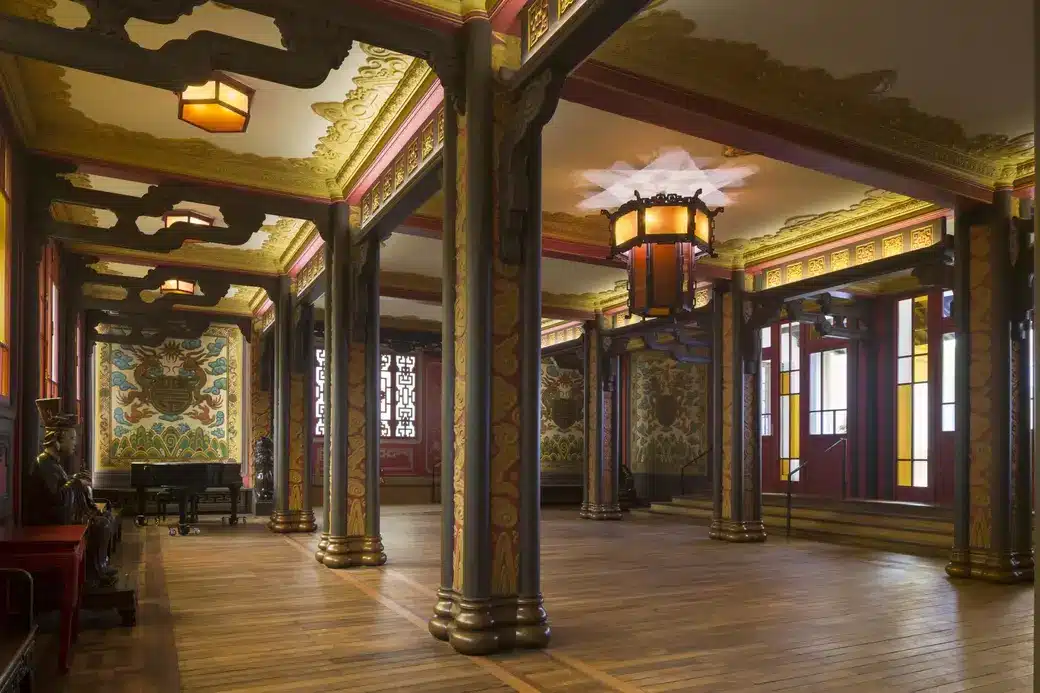
Another highly sought-after building is the Maison des étudiants de l’Asie du Sud-Est (Southeast Asian Students’ House), inaugurated in 1930 under the name Maison de l’Indochine (Indochina House).
Its architecture and elegant interiors make it an ideal setting for evoking the colonial past or diplomatic spaces.
The large lounge on the ground floor, for example, still hosts various celebrations that punctuate the life of the House throughout the year, particularly Tet, or Vietnamese New Year. Its colourful décor and architecture are inspired by the temples and palaces of Southeast Asia.
It was therefore the ideal setting for Régis Wargnier’s film Indochine, in which Catherine Deneuve and Dominique Blanc meet Vincent Pérez at an auction.
The venue is also used in Patrice Leconte’s The Girl on the Bridge (La Fille sur le pont ), proof of its ability to change completely depending on the staging.

The International House, an institutional and modular setting
Another central building on campus, the International House occupies a special place in the cinematic geography of the Cité Internationale Universitaire.
Funded by John Rockefeller, its architecture is the work of Jens Fredrick Larson, a specialist in student buildings who sought to combine elements of American universities such as New York, Berkeley and Chicago with a more French inspiration, the Château de Fontainebleau.
With its monumental volumes, large halls, lounges and communal facilities, it offers filmmakers an immediately recognisable setting, capable of embodying both an official institution and a place of passage or socialising.
It appears notably in Romantics Anonymous (Les Émotifs anonymes), where certain scenes make use of its interior spaces, but also in Me, Myself and Mum (Les Garçons et Guillaume, à table !), which notably uses its swimming pool. More recently, the International House also appears in The Count of Monte-Cristo (Le Comte de Monte-Cristo), lending its institutional appearance to a particularly striking sequence.
This is a perfect example of the campus’s ability to transform itself, depending on the film, into a place of learning, power or social representation.

One campus, very different films
The architectural diversity of the Cité Universitaire allows you to move from one world to another without interruption.
It has also been the setting for Jean-Paul Salomé’s Female Agents (Les Femmes de l’ombre), Éric Lartigau’s F.B.I. Frog Butthead Investigators (Mais qui a tué Pamela Rose ?), Joann Sfar’s Gainsbourg: A Heroic Life (Gainsbourg vie héroïque), Florent-Emilio Siri’s Cloclo and Valérie Lemercier’s Aline.
Among the anecdotes from the shoot, one of the most spectacular is that of the film La Fille de l’air. One of the sequences re-enacts Michel Vaujour’s real escape from the Santé prison in 1986, aided by his wife Nadine Vaujour. The character played by Béatrice Dalle lands… by helicopter in the heart of the Cité Universitaire.
This scene, rare in Paris, was made possible by the size and exceptional layout of the site — and sums up the freedom that this place offers filmmakers.
The Cité is in turn a historical setting, an American campus, a place of conspiracy, romance or learning, and sometimes, as in La Fille de l’air, plays its own role.

A City of Peace turned into a fictional setting
Conceived as a ‘City of Peace’, the Cité Internationale Universitaire de Paris is now also one of the most filmed locations in the capital. On screen, it becomes a place of projection, memory, fiction and metamorphosis. A place of learning in reality, it is also a formidable cinematographic laboratory, where individual stories intersect with grand collective narratives.
It’s another way to explore Paris, following in the footsteps of students… and cameras.